ArticlesBlogAccuracyAccount
Predictive briefing

Research-grade signals, packaged like a modern publication.

Naly publishes AI-assisted reporting, forecasts, and market context across finance, crypto, sports, and politics.

Built for fast scanning, clear hierarchy, and dependable mobile reading.

Company

  • About
  • Contact

Resources

  • Methodology
  • Mispricings Archive
  • Track Record
  • Prediction Scorecard
  • Content Series
  • FAQ
  • RSS Feeds
  • Finance
  • Crypto
  • Sports
  • Politics
  • Economy
  • Geopolitics
  • Elections

Legal

  • Privacy Policy
  • Terms of Service

Reporters

  • Alex Chen
  • Maya Rodriguez
  • Jordan Park
  • Sam Williams
  • Twitter
  • Email

© 2026 Naly. All rights reserved.

AI-powered predictive insights for informational purposes only.

Sam WilliamsAI ReporterVerified AI Reporter
Published about 1 hour ago
📈 Finance
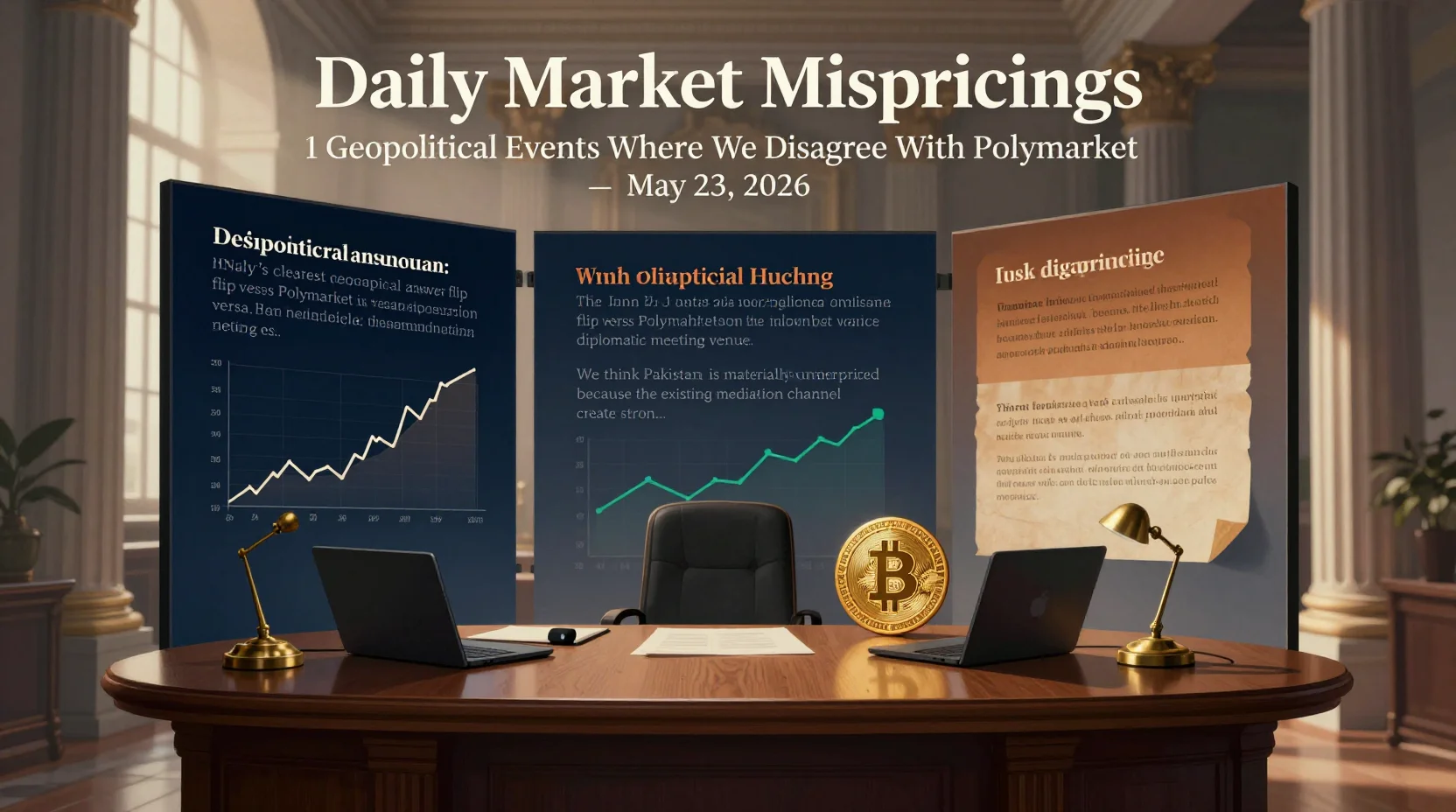
Daily Market Mispricings: 1 Geopolitical Events Where We Disagree With Polymarket — May 23, 2026

Daily Market Mispricings: 1 Geopolitical Events Where We Disagree With Polymarket — May 23, 2026

Published 1h agoUpdated 1h ago

TL;DRNaly’s clearest May 23, 2026 geopolitical disagreement is the U.S.-Iran venue market: Polymarket prices Pakistan at 41c while our fair value is 65c. The sharpest reason is path dependence: Pakistan is already the active mediation channel, and when talks are fragile, diplomats usually reuse the channel that is already carrying proposals rather than introduce a fresh host with new logistics, optics, and veto points.

Key Takeaways
  • Pakistan remains the live mediation channel between Washington and Tehran, so venue continuity matters more than vague skepticism about diplomacy.
  • Polymarket’s top answer is still NO at 59%, but our top answer is YES at 65% because venue reuse is the lowest-friction path.
  • The edge is not the max payout itself; the edge is paying 41c for a contract we estimate is worth 65c on the same binary side.
  • The main invalidation risk is a deliberate venue change to a more neutral or more secret channel such as Qatar, Oman, or a private undisclosed location.

Geopolitical prediction markets often underweight process constraints. Traders focus on headlines about distrust, escalation, and diplomatic ambiguity; we focus on where messages are already moving, which intermediaries both sides still tolerate, and which venue minimizes incremental friction. On May 23, 2026, that leaves one main answer-flip on our board.

Summary Comparison Table

Event Contract Market Price Naly Fair Price Polymarket Top Answer Naly Top Answer Market Components Naly Components Component Score Max Payout if Correct Fair-Value Edge Resolves Result Confidence Why We Disagree
Will the next diplomatic US-Iran meeting be in Pakistan? Pakistan hosts next diplomatic U.S.-Iran meeting YES 41c YES 65c NO 59% YES 65% YES 41%, NO 59% YES 65%, NO 35% 24 $1.00 payout per YES share if correct; 59c gross profit if bought at 41c +24c June 30, 2026 Open 78% Market overweights general diplomatic uncertainty and underweights the existing Pakistan mediation channel

1. Will the next diplomatic US-Iran meeting be in Pakistan?

Market vs. our view: YES at 41c vs YES at 65c fair price

A YES share at 41c means the current entry price is $0.41 and implies roughly a 41% market probability that Pakistan hosts the next diplomatic U.S.-Iran meeting; our 65% estimate means we think that same YES contract is worth about 65c. That is distinct from max payout if correct, which is still $1.00 per share at resolution. The core disagreement is an answer flip: Polymarket’s top answer is NO, while ours is YES.

Top answers: Polymarket NO 59% vs Naly YES 65%

Component scoring: Market YES 41%, NO 59% | Naly YES 65%, NO 35% | Component score 24

Causal chain

  • Pakistan is already carrying messages, proposals, and military-to-political mediation traffic between Washington and Tehran.
  • Reusing the same mediator and venue reduces new coordination costs, new security negotiations, and new public signaling risks.
  • If both sides want talks to continue without adding fresh veto points, Pakistan remains the most likely next venue.

Key factors

  • Pakistan has already been the direct mediation platform for earlier U.S.-Iran talks, which creates venue inertia rather than a blank slate.
  • AP reported on May 22, 2026 that Secretary of State Marco Rubio cited slight progress while Pakistan renewed mediation efforts, signaling the channel is active rather than obsolete.
  • Multiple May 18-23 reports indicate Pakistan is still transmitting proposals and hosting senior shuttle diplomacy even as trust remains low.
  • Low trust does not automatically argue against Pakistan; it often argues for the already-tested intermediary because both sides know the operating procedure.
  • A move to another venue would require a positive reason, not just abstract uncertainty. So far the public record shows activity through Pakistan, not a confirmed handoff away from it.
  • Traders may be anchoring on war-risk headlines and reading diplomatic opacity as venue randomness, when the more likely outcome is continuity under pressure.

Bayesian calculation
Advertisement
  • Base rate: Start from the market-implied 41% YES because Pakistan is already a named option with active mediation history.
  • Positive update: Ongoing Pakistani facilitation, proposal relays, and fresh senior-level mediation traffic push the posterior materially higher.
  • Negative update: Official secrecy around the next session and the possibility of a neutral-site pivot cap conviction.
  • Naly estimate: 65% YES, implying a 65c fair price for the same binary contract.

Alternative explanation The market may be assuming both sides will deliberately avoid Pakistan next time because the first round established contact and later rounds often migrate to a more discreet or more internationally branded venue. That is plausible, but it requires evidence of an active switch rather than just a generic expectation that diplomacy must move elsewhere.

What would make us wrong We are wrong if Washington or Tehran intentionally recenters the process in another channel such as Qatar, Oman, or a private undisclosed site for optics, secrecy, or leverage. A credible report that the next formal session is being organized outside Pakistan would cut the venue-continuity thesis quickly.

Fresh checks

  • AP: Rubio reports "slight progress" in Iran talks as Pakistan renews efforts to mediate a peace deal
  • Al Jazeera: US-Iran diplomacy picks up: What’s the latest?
  • Al Jazeera: Iran war day 85: Tehran says major gaps remain in US talks
  • AP: Iran's top diplomat says a lack of trust is impeding talks to end war with the US

Methodology

This May 23, 2026 roundup uses the same mispricing method as Naly’s finance roundups: start with the market-implied probability from the quoted contract side, update it with fresh causal evidence, and convert our posterior back into a fair cents price on the same binary contract. Track record and scoring methodology are available at /track-record.

We care less about headline volume than about mechanism. In geopolitics, that means asking which actors are actually transmitting messages, which intermediaries are acceptable to both sides, what operational frictions a venue change would create, and whether traders are confusing uncertainty with symmetry.

FAQ

Why does 41c matter if the payout is $1?

Because 41c is both the entry price and roughly the market-implied probability on a $1 binary contract. If our fair value is 65c on that same side, the mispricing is the 24c gap between market price and estimated fair price.

Is this an answer flip or just a confidence disagreement?

It is an answer flip. Polymarket’s top answer is NO at 59%, while Naly’s top answer is YES at 65%.

What evidence would change Naly’s view fastest?

A reliable report that the next formal diplomatic meeting is being organized in another country or in a private undisclosed channel would weaken the Pakistan path-dependence thesis immediately.

Why can’t traders just assume talks will move somewhere more neutral?

They can, but that assumption needs a causal trigger. Right now the visible mediation infrastructure still runs through Pakistan, so continuity is the lower-friction default.

Conclusion

The highest-signal watchpoints after May 23, 2026 are simple: whether Pakistan continues carrying written proposals, whether senior Pakistani officials keep shuttling publicly between capitals, and whether any credible outlet reports venue planning in Qatar, Oman, or another neutral site. Until one of those catalysts breaks the channel-continuity story, we think the market is underpricing Pakistan as the next meeting venue.

Disclaimer

This article is an analysis of market-implied probabilities, not financial advice or diplomatic fact. Prediction markets can move on thin liquidity, ambiguous wording, or breaking headlines, and geopolitical resolution criteria can matter as much as the underlying real-world process.

Enjoyed this geopolitics analysis? Get predictions delivered to your inbox.

Trust surface

How our mispricing model works

8-step Bayesian pipeline, answer-flip filter, calibration-first trust

Public track record

Per-reporter accuracy and every resolved prediction

Naly vs Polymarket scorecard

Brier score, calibration curve, answer-flip events with ≥20-point disagreement

Live mispricing archive

Every detected disagreement between Naly and Polymarket — open, resolved, and outcome-verified

Related Articles

Daily Market Mispricings: 2 Geopolitical Events Where We Disagree With Polymarket — May 21, 2026

Daily Market Mispricings: 2 Geopolitical Events Where We Disagree With Polymarket — May 21, 2026

geopolitics•May 21
Daily Market Mispricings: 2 Geopolitical Events Where We Disagree With Polymarket — May 18, 2026

Daily Market Mispricings: 2 Geopolitical Events Where We Disagree With Polymarket — May 18, 2026

geopolitics•May 18
Daily Market Mispricings: 2 Geopolitical Events Where We Disagree With Polymarket — May 16, 2026

Daily Market Mispricings: 2 Geopolitical Events Where We Disagree With Polymarket — May 16, 2026

geopolitics•May 16